
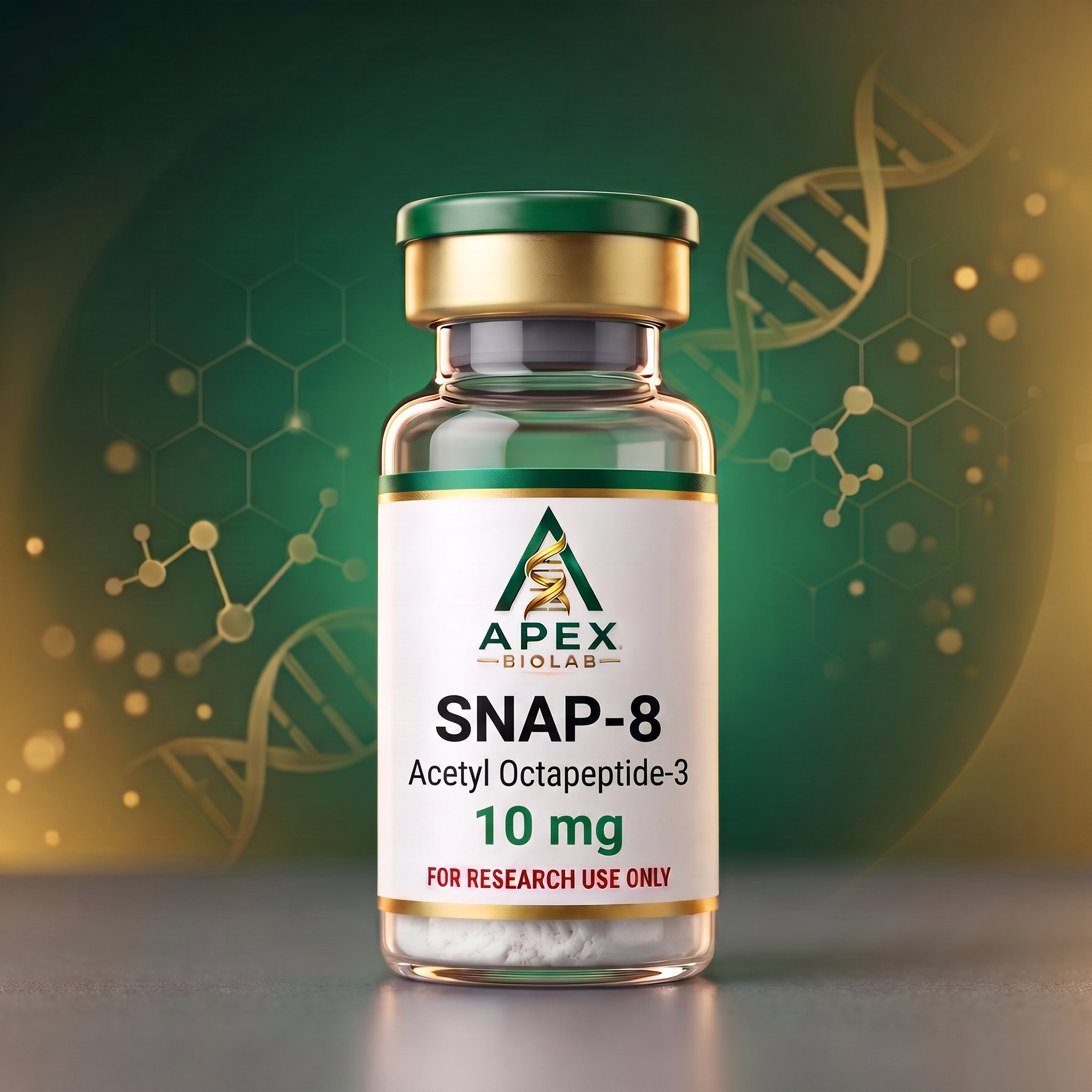
SNAP-8
Eight-amino-acid peptide studied for its effect on nerve signalling and the pathways that control muscle contraction.
For Research Use Only
Sold strictly for laboratory research. Not for human or veterinary use, ingestion, or clinical/diagnostic application.
Pricing coming soon
Contact us for a quote on this batch.
Bacteriostatic water included
About this peptide
SNAP-8 is a synthetic peptide made of eight amino acids, modelled on a fragment of SNAP-25 — a protein that helps nerve cells release their chemical messengers. Researchers study it for the way it can dial down the signal that tells muscles to contract, making it a useful tool for exploring nerve-to-muscle communication. Its action is reversible and does not damage the proteins involved, which makes it an active subject in neurotransmission and muscle-relaxation research.
Why researchers reach for SNAP-8
Nerve-signal modulation
Studied for softening the signal that nerves send to muscles, offering a way to model reduced neuromuscular activity in research settings.
Reversible, non-enzymatic action
Works by temporarily occupying the signalling machinery rather than destroying it, so its effects wear off — a key difference researchers value.
Well-characterised pathway
Targets the SNARE complex, one of the best-understood mechanisms in cell biology, giving researchers a clear frame for interpreting results.
Key features
- 99%+ purity verified by HPLC
- Synthetic octapeptide (eight amino acids)
- Lyophilised powder for stability
- 10 mg research vial
- Bacteriostatic water included
- For laboratory research use only
How it works
SNAP-25 mimicry
SNAP-8 (Ac-Glu-Glu-Met-Gln-Arg-Arg-Ala-Asp-NH2) copies part of the SNAP-25 protein and takes its place during assembly of the SNARE complex.
Competitive SNARE inhibition
The altered SNARE complex is less stable, which reduces how efficiently nerve endings can release acetylcholine.
Reduced acetylcholine release
With less acetylcholine crossing the neuromuscular junction, the contraction signal to muscle tissue is dampened — reversibly and without degrading any protein.
Research dosage guidelines
Reference ranges only — reproduced from published preclinical literature. Not a recommendation for human use.
| Range | Reported dose | Note |
|---|---|---|
| Reported research range | 100–500 mcg | Per administration, as reported in research literature. |
| Frequency | 1× daily or weekly | Protocols describe either a once-daily schedule or a single weekly administration. |
| Typical reconstitution | 2 mL bacteriostatic water | Yields 5 mg/mL (5000 mcg/mL). |
Tracking this compound? Registered researchers can log active SNAP-8 protocols in their private Research Log.
Timing in research protocols
Research protocols report 100–500 mcg per administration, given once daily or once weekly.
- The reported research range is 100–500 mcg per administration.
- Protocols describe either a once-daily schedule or a single weekly administration.
- No specific time of day, fasting requirement, or meal relationship has been established in the literature.
- Reference information only — no peer-reviewed human dosing protocol has been published for this peptide.
Drawn from published research protocols and pharmacology literature. Reference information for laboratory research only — not an instruction or guidance for use.
Technical specifications
- Scientific name
- Acetyl octapeptide-3 (acetyl glutamyl heptapeptide-1)
- Sequence
- Ac-Glu-Glu-Met-Gln-Arg-Arg-Ala-Asp-NH2
- CAS number
- 868844-74-0
- Molecular weight
- ~1075 Da
- Purity
- 99%+ (HPLC)
- Form
- Lyophilised white powder
- Vial size
- 10 mg
- Reconstitution
- 2 ml bacteriostatic water
- Storage (unopened)
- -20 degrees C, protected from light
- Storage (reconstituted)
- 2-8 degrees C, use within 30 days
Published research
Peer-reviewed literature on SNAP-8. Links open in a new tab.
Research use notice
SNAP-8 is supplied strictly for laboratory research. Published data on this peptide remains limited and peer-reviewed human dosing protocols have not been established. Not for human or veterinary use, ingestion, or clinical application.