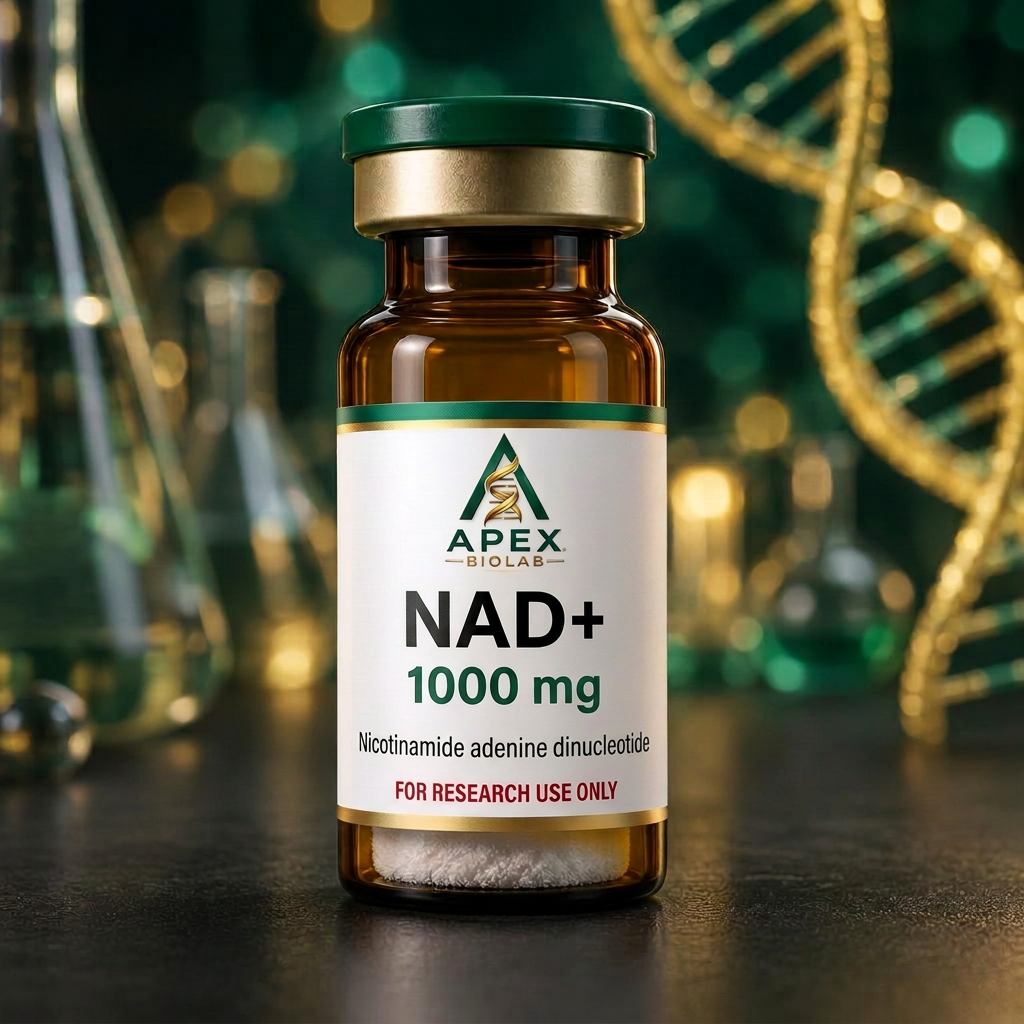
NAD+
Natural cell cofactor studied for energy production, DNA repair, and healthy ageing pathways.
For Research Use Only
Sold strictly for laboratory research. Not for human or veterinary use, ingestion, or clinical/diagnostic application.
The lower price is applied automatically once your cart holds 5 or more of this vial.
Bacteriostatic water included
About this peptide
NAD+ is a naturally occurring molecule that cells need to turn nutrients into usable energy. It also supports enzymes involved in DNA repair, stress responses, and normal cell maintenance. Researchers study how NAD+ levels relate to mitochondrial function and changes that occur as cells age.
Why researchers reach for NAD+
Sirtuin substrate
Fuels SIRT1-7 deacylation reactions.
PARP support
Required for DNA-damage response enzymes.
Mitochondrial redox
Central to Complex I electron transfer studies.
Key features
- ≥99% HPLC purity
- Pharma-grade oxidized form
- Mass-spec verified
- Cold-chain dispatch
How it works
Redox cofactor
Cycles between NAD+ and NADH during catabolism.
Enzyme substrate
Consumed by sirtuins, PARPs, CD38 and SARM1.
Metabolic hub
Links glycolysis, TCA cycle, and OXPHOS.
Research dosage guidelines
Reference ranges only — reproduced from published preclinical literature. Not a recommendation for human use.
| Range | Reported dose | Note |
|---|---|---|
| Typical reconstitution | 3 mL bacteriostatic water | Yields ~333 mg/mL |
| Starting / titration | 25–50 mg, 2–3× weekly | Reference only |
| Common research range | 50–100 mg, 2–3× weekly | Reference only |
| Higher end | 100–200 mg, 2–3× weekly | Reference only |
Tracking this compound? Registered researchers can log active NAD+ protocols in their private Research Log.
Timing in research protocols
Studied as a single slow infusion in controlled settings; no diurnal pattern established.
- The most cited human study (Grant et al., Frontiers in Aging Neuroscience, 2019) used a continuous 6-hour intravenous infusion at 3 µmol/min.
- Plasma and urinary changes only emerged around the 2-hour mark, with increased urinary excretion by 6 hours — the kinetics are infusion-rate driven, not circadian.
- No published study establishes an optimal time of day, a meal relationship, or a standard repeat interval.
- Weekly or fortnightly infusion schedules seen outside the literature are not trial-derived.
Drawn from published research protocols and pharmacology literature. Reference information for laboratory research only — not an instruction or guidance for use.
Technical specifications
- Scientific name
- β-Nicotinamide adenine dinucleotide (NAD+), disodium salt
- Molecular formula
- C21H27N7O14P2
- Molecular weight
- 663.43 g/mol
- Purity
- ≥99% (HPLC)
- Form
- Lyophilized powder
- Vial size
- 1000 mg
- Storage (lyophilised vial)
- Cool, dry and protected from light
- Storage (after reconstitution)
- 2–8°C
Published research
Peer-reviewed literature on NAD+. Links open in a new tab.
Research use notice
Sold for in vitro laboratory research only. Not for human or veterinary use, diagnosis, or therapy.