
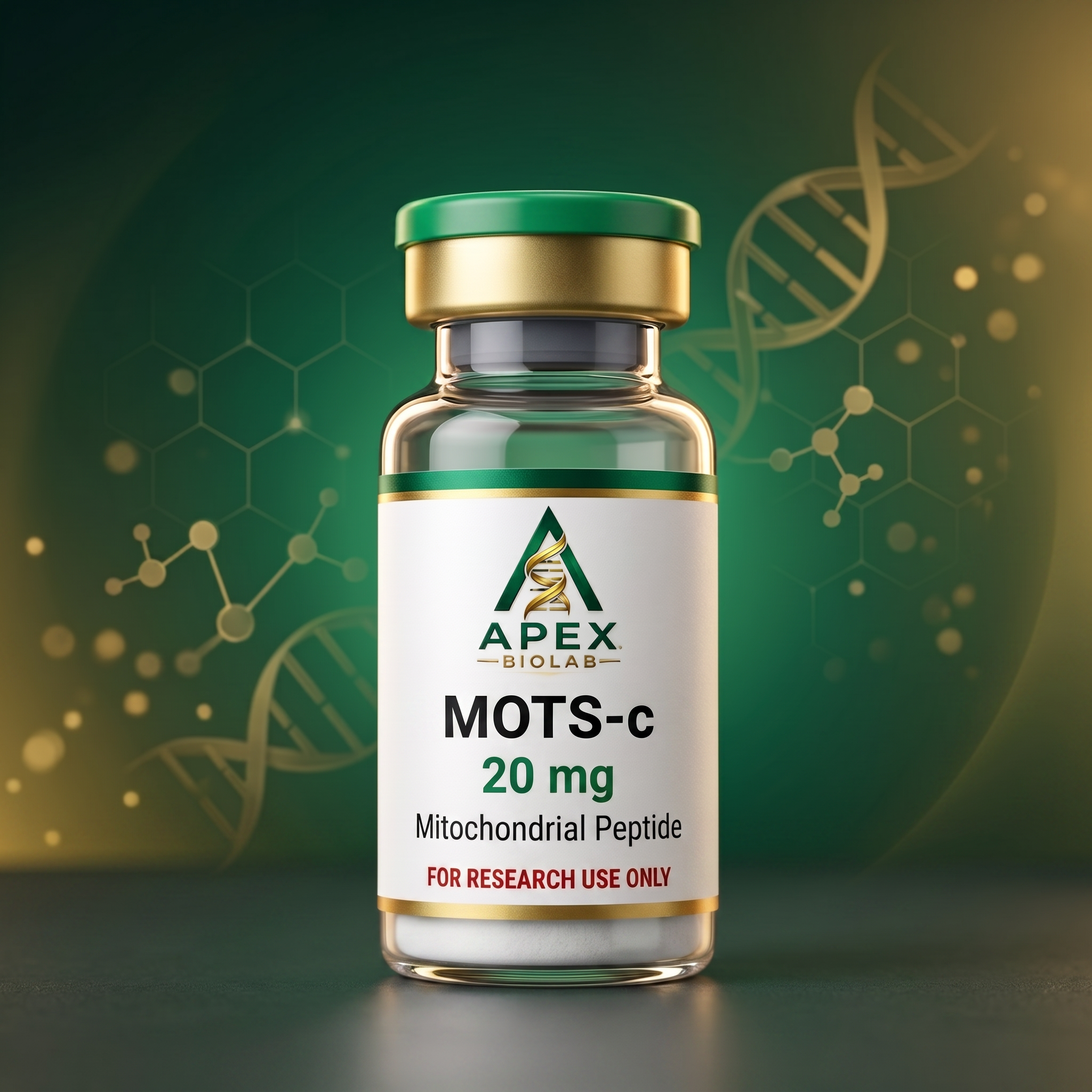
MOTS-c
Mitochondrial peptide studied for energy use, blood-sugar control, and exercise response.
For Research Use Only
Sold strictly for laboratory research. Not for human or veterinary use, ingestion, or clinical/diagnostic application.
The lower price is applied automatically once your cart holds 5 or more of this vial.
Bacteriostatic water included
About this peptide
MOTS-c is a 16-amino-acid peptide produced from genetic material inside mitochondria, the parts of cells that generate energy. Researchers study how it affects the way cells use sugar and fat, especially during metabolic stress and exercise. Much of the work focuses on AMPK, an important sensor that helps cells manage energy.
Why researchers reach for MOTS-c
AMPK activation
Engages the folate-methionine-AMPK axis in preclinical work.
Insulin sensitivity
Improved glucose disposal in rodent metabolic models.
Exercise mimetic
Referenced in mitochondrial biogenesis and endurance research.
Key features
- ≥99% HPLC purity
- 16-residue mitochondrial peptide
- Mass-spec verified
- Cold-chain dispatch
How it works
Metabolic sensor
Modulates folate cycle and AICAR accumulation.
AMPK signaling
Downstream activation of AMPK-driven catabolic programs.
Mitochondrial cross-talk
Communicates mitochondrial state to the nucleus.
Research dosage guidelines
Reference ranges only — reproduced from published preclinical literature. Not a recommendation for human use.
| Range | Reported dose | Note |
|---|---|---|
| Typical reconstitution | 2 mL bacteriostatic water | Yields 10 mg/mL (10 000 mcg/mL) |
| Reported research range | 5–10 mg/week (split) | Reference only |
Tracking this compound? Registered researchers can log active MOTS-c protocols in their private Research Log.
Timing in research protocols
Morning or pre-exercise timing is preclinical inference; human trials are only now under way.
- A phase 2a trial (NCT07505745) is recruiting, using subcutaneous administration over a 12-week period; the regimen detail is not yet public.
- Existing human data cover an analogue (CB4211) rather than native MOTS-c.
- The exercise-mimetic rationale behind morning or pre-exercise dosing comes from rodent AMPK work, not human trials.
- No published human time-of-day, meal or cycle-length evidence exists yet.
Drawn from published research protocols and pharmacology literature. Reference information for laboratory research only — not an instruction or guidance for use.
Technical specifications
- Sequence
- MRWQEMGYIFYPRKLR
- Molecular weight
- 2174.6 g/mol
- Purity
- ≥99% (HPLC)
- Form
- Lyophilized powder
- Vial size
- 20 mg
- Storage (lyophilised vial)
- Cool, dry and protected from light
- Storage (after reconstitution)
- 2–8°C
Published research
Peer-reviewed literature on MOTS-c. Links open in a new tab.
Research use notice
Sold for in vitro laboratory research only. Not for human or veterinary use, diagnosis, or therapy.