
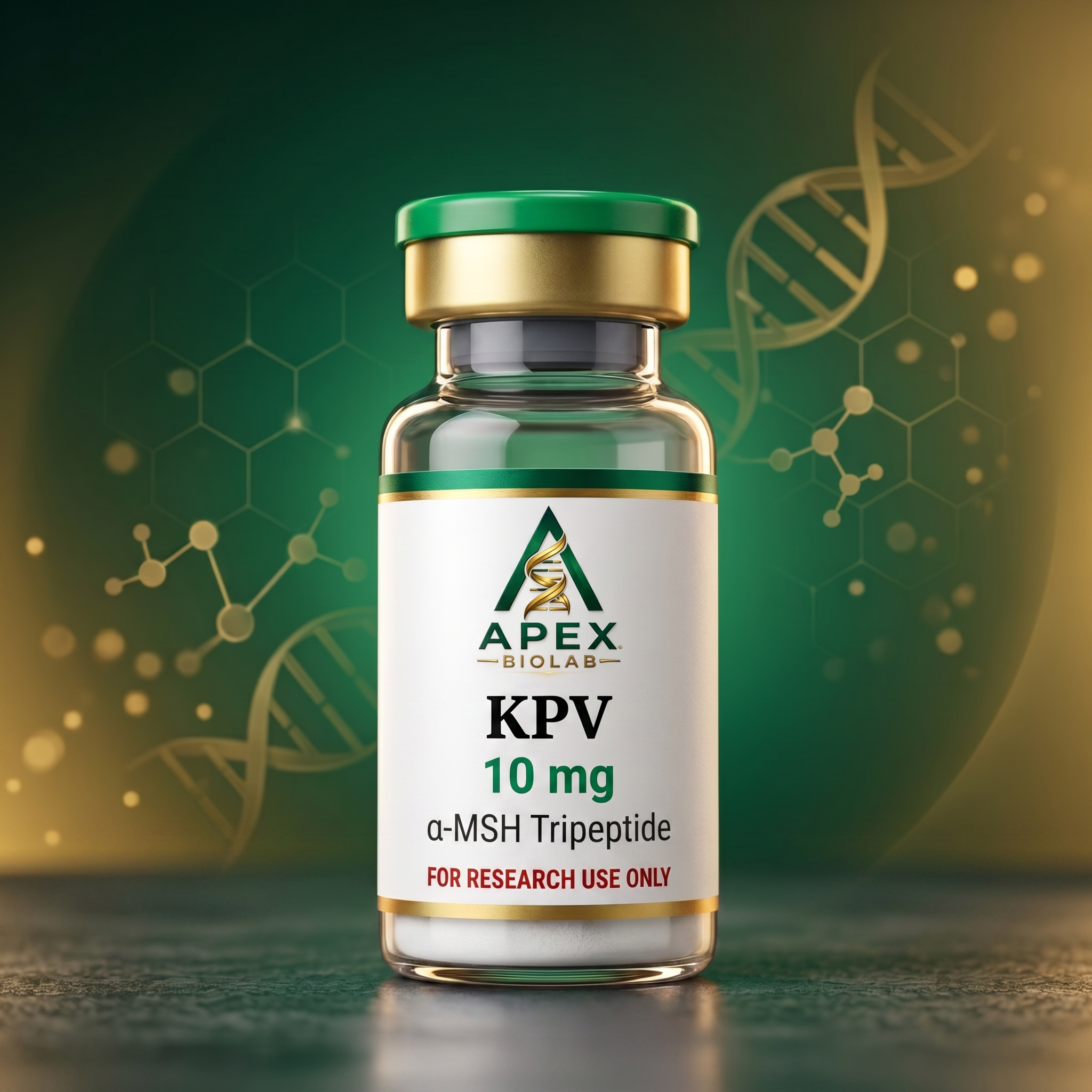
KPV
Three-amino-acid peptide studied for inflammation in the gut, skin, and immune cells.
For Research Use Only
Sold strictly for laboratory research. Not for human or veterinary use, ingestion, or clinical/diagnostic application.
The lower price is applied automatically once your cart holds 5 or more of this vial.
Bacteriostatic water included
About this peptide
KPV is a targeted tripeptide derived from the terminal three amino acids of alpha-MSH, a naturally occurring signalling hormone. In laboratory research, KPV is widely studied for its ability to calm inflammatory cascades directly at the cellular level—particularly in the gut lining, skin tissue, and active immune cells. By dampening pro-inflammatory signals and helping restore tissue balance, it has become a primary focus in gut health and barrier-repair models. Crucially, unlike the parent alpha-MSH molecule, KPV carries out these anti-inflammatory effects without stimulating pigment production or skin darkening.
Why researchers reach for KPV
Mucosal inflammation
Studied in colitis and IBD rodent models.
Cytokine suppression
Reduces NF-κB driven cytokine output in vitro.
No pigmentation effect
Retains anti-inflammatory core without melanocortin-1 activity.
Key features
- ≥99% HPLC purity
- α-MSH C-terminal tripeptide
- Mass-spec verified
- Cold-chain dispatch
How it works
NF-κB inhibition
Suppresses TNF-α induced NF-κB activation.
Epithelial uptake
Enters cells via PepT1 transporter in research models.
Th17 modulation
Alters IL-17 and IL-1β expression in intestinal studies.
Research dosage guidelines
Reference ranges only — reproduced from published preclinical literature. Not a recommendation for human use.
| Range | Reported dose | Note |
|---|---|---|
| Typical reconstitution | 2 mL bacteriostatic water | Yields 5 mg/mL (5000 mcg/mL) |
| Reported research range | 200–500 mcg/day | Reference only |
Tracking this compound? Registered researchers can log active KPV protocols in their private Research Log.
Timing in research protocols
No human pharmacokinetic study; rodent data suggest a short window of action.
- Secondary sources citing rodent data place peak plasma levels roughly 45–90 minutes after subcutaneous administration, with clearance in 4–6 hours.
- That short profile is consistent with rapid enzymatic degradation of an unmodified tripeptide.
- Primary mechanistic literature is in vitro and in rodent colitis models, with no human dosing schedule.
- No evidence-based time of day or meal relationship exists.
Drawn from published research protocols and pharmacology literature. Reference information for laboratory research only — not an instruction or guidance for use.
Technical specifications
- Sequence
- Lys-Pro-Val
- Molecular weight
- 342.4 g/mol
- Purity
- ≥99% (HPLC)
- Form
- Lyophilized powder
- Vial size
- 10 mg
- Storage (lyophilised vial)
- Cool, dry and protected from light
- Storage (after reconstitution)
- 2–8°C
Published research
Peer-reviewed literature on KPV. Links open in a new tab.
Research use notice
Sold for in vitro laboratory research only. Not for human or veterinary use, diagnosis, or therapy.