
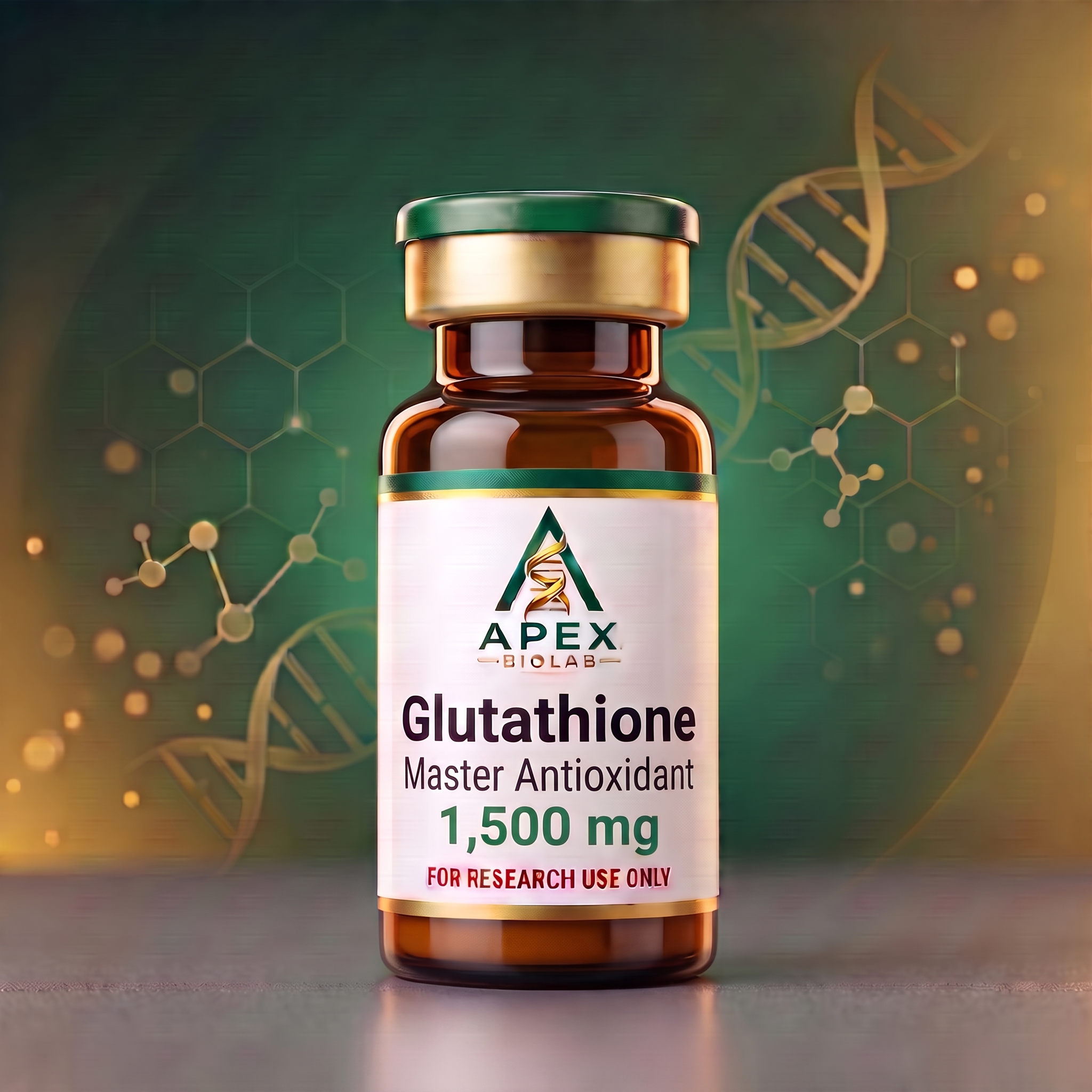
Glutathione
The body's master antioxidant — a small three-amino-acid molecule studied for protecting cells from oxidative stress.
For Research Use Only
Sold strictly for laboratory research. Not for human or veterinary use, ingestion, or clinical/diagnostic application.
Pricing coming soon
Contact us for a quote on this batch.
Bacteriostatic water included
About this peptide
Glutathione is a tiny molecule made from three amino acids that every cell in the body produces. Its main job is to mop up harmful by-products called free radicals and to help the liver neutralise toxins. Levels naturally fall with age and stress, so researchers study it for its role in cellular protection, liver function, immune health and skin brightness.
Why researchers reach for Glutathione
Antioxidant defence
Studied as the cell's primary internal antioxidant, neutralising free radicals that damage proteins, fats and DNA.
Detoxification support
Researched for its central role in liver detox pathways, where it binds toxins so they can be cleared.
Immune and skin research
Examined in immune-cell function studies and in skin research for its effect on melanin production.
Key features
- 99%+ purity verified by HPLC
- Reduced glutathione (GSH) tripeptide
- Lyophilised powder for stability
- 1,500 mg research vial
- Bacteriostatic water included
- For laboratory research use only
How it works
Free-radical scavenging
The thiol (-SH) group on its cysteine donates electrons to neutralise reactive oxygen species, turning glutathione into its oxidised form (GSSG).
Enzyme cofactor
Acts as the substrate for glutathione peroxidase and glutathione S-transferase, enzymes that break down peroxides and tag toxins for removal.
Antioxidant recycling
Helps regenerate vitamins C and E, keeping the wider antioxidant network active.
Research dosage guidelines
Reference ranges only — reproduced from published preclinical literature. Not a recommendation for human use.
| Range | Reported dose | Note |
|---|---|---|
| Commonly researched range | 100–600 mg, 1–3× weekly | Reference only |
| Higher protocols | 400–600 mg, 1–3× weekly | Reference only |
| Typical reconstitution | 3 mL bacteriostatic water | Yields 500 mg/mL. |
Tracking this compound? Registered researchers can log active Glutathione protocols in their private Research Log.
Timing in research protocols
One to three administrations weekly — clock time was not studied.
- Research protocols commonly report 100–600 mg one to three times weekly, with higher protocols using 400–600 mg at the same frequency.
- No trial has compared morning versus evening dosing or fed versus fasted state.
Drawn from published research protocols and pharmacology literature. Reference information for laboratory research only — not an instruction or guidance for use.
Technical specifications
- Scientific name
- L-γ-glutamyl-L-cysteinyl-glycine (reduced glutathione, GSH)
- Sequence
- γ-Glu-Cys-Gly
- CAS number
- 70-18-8
- Molecular weight
- ~307.3 Da
- Purity
- 99%+ (HPLC)
- Form
- Lyophilised white powder
- Vial size
- 1,500 mg
- Reconstitution
- 3 ml bacteriostatic water
- Concentration after reconstitution
- 500 mg/mL
- Storage (unopened)
- -20 degrees C, protected from light
- Storage (reconstituted)
- 2-8 degrees C, use within 30 days
Published research
Peer-reviewed literature on Glutathione. Links open in a new tab.
Research use notice
Glutathione is supplied strictly for laboratory research. Not for human or veterinary use, ingestion, or clinical application.