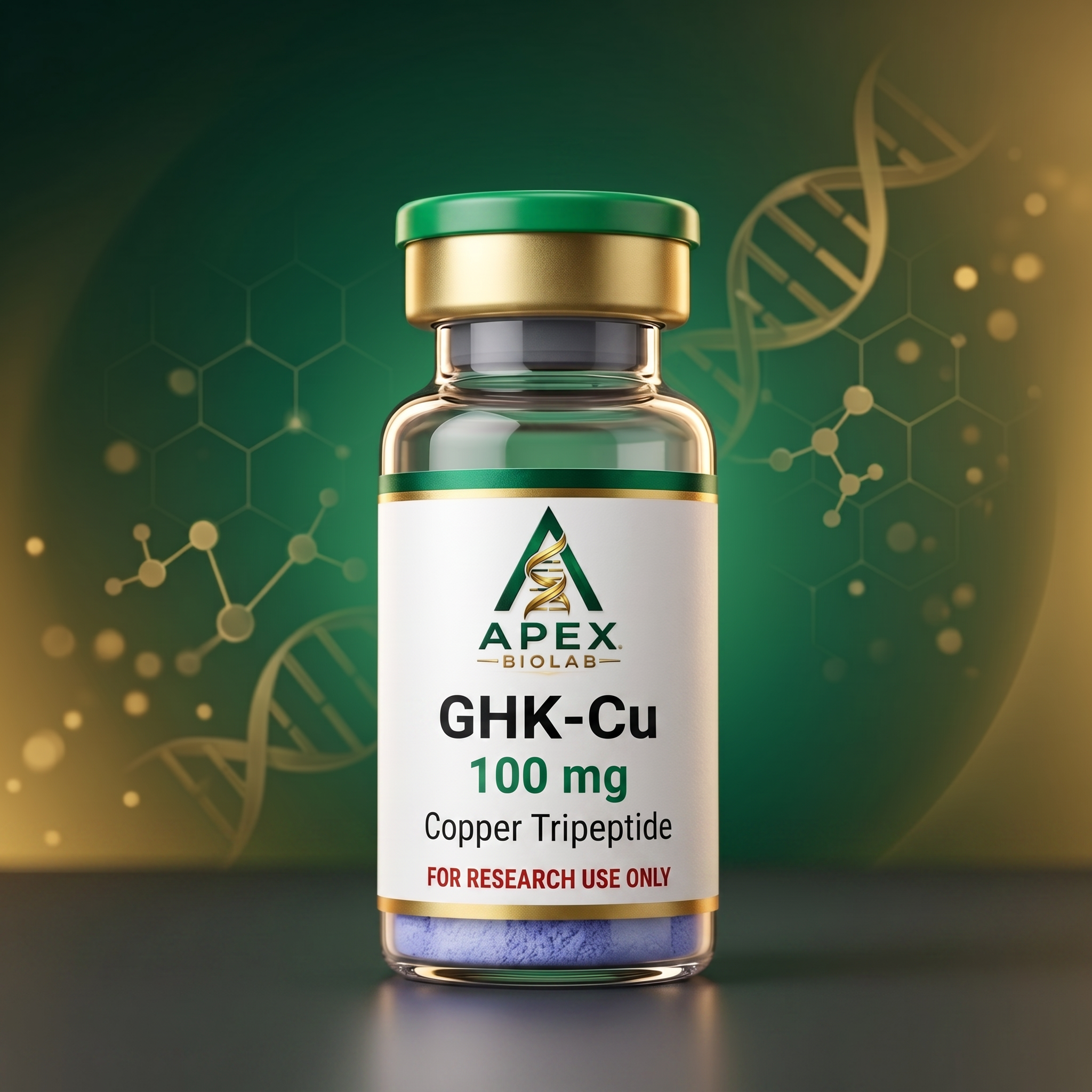
GHK-Cu
Copper-binding peptide studied for skin renewal, wound repair, and hair-follicle activity.
For Research Use Only
Sold strictly for laboratory research. Not for human or veterinary use, ingestion, or clinical/diagnostic application.
The lower price is applied automatically once your cart holds 5 or more of this vial.
Bacteriostatic water included
About this peptide
GHK-Cu is a naturally occurring three-amino-acid peptide that binds to copper. Researchers study how it influences collagen and other structures that help keep skin and connective tissue strong. Laboratory work also explores its role in wound signalling, antioxidant activity, and hair-follicle function.
Why researchers reach for GHK-Cu
Matrix remodeling
Modulates collagen and glycosaminoglycan expression in dermal fibroblast studies.
Follicle signaling
Referenced in hair-cycle and follicular stem-cell research.
Antioxidant chaperone
Delivers Cu(II) to enzymes such as superoxide dismutase in vitro.
Key features
- ≥99% HPLC purity
- Lyophilized copper-peptide complex
- Batch-verified by mass spectrometry
- Cold-chain dispatch
How it works
Copper delivery
Chaperones Cu(II) into cellular pathways implicated in redox balance.
ECM modulation
Alters expression of collagen, decorin and metalloproteinase genes in fibroblast models.
Regenerative signaling
Referenced in wound-closure and follicle-neogenesis literature.
Research dosage guidelines
Reference ranges only — reproduced from published preclinical literature. Not a recommendation for human use.
| Range | Reported dose | Note |
|---|---|---|
| Typical reconstitution | 2 mL bacteriostatic water | Yields 50 mg/mL |
| Alternative reconstitution | 3 mL bacteriostatic water | Yields ~33.3 mg/mL — the gentler dilution, useful if the compound causes skin irritation |
| Reported research range | 1–2 mg/day | Reference only |
Tracking this compound? Registered researchers can log active GHK-Cu protocols in their private Research Log.
Timing in research protocols
Only topical, once-daily use appears in registered research.
- Credible human data are limited to topical wound-healing work; the one registered trial (NCT07436586-series, recruiting) uses a once-daily topical gel.
- Foundational mechanistic work is rat wound-chamber based.
- No trial-validated schedule, clock time or meal relationship exists for injectable use.
Drawn from published research protocols and pharmacology literature. Reference information for laboratory research only — not an instruction or guidance for use.
Technical specifications
- Sequence
- Gly-His-Lys · Cu(II)
- Molecular weight
- 340.8 g/mol (chelate)
- Purity
- ≥99% (HPLC)
- Form
- Lyophilized powder
- Vial size
- 100 mg
- Storage (lyophilised vial)
- Cool, dry and protected from light
- Storage (after reconstitution)
- 2–8°C
Published research
Peer-reviewed literature on GHK-Cu. Links open in a new tab.
Research use notice
Sold for in vitro laboratory research only. Not for human or veterinary use, diagnosis, or therapy.