
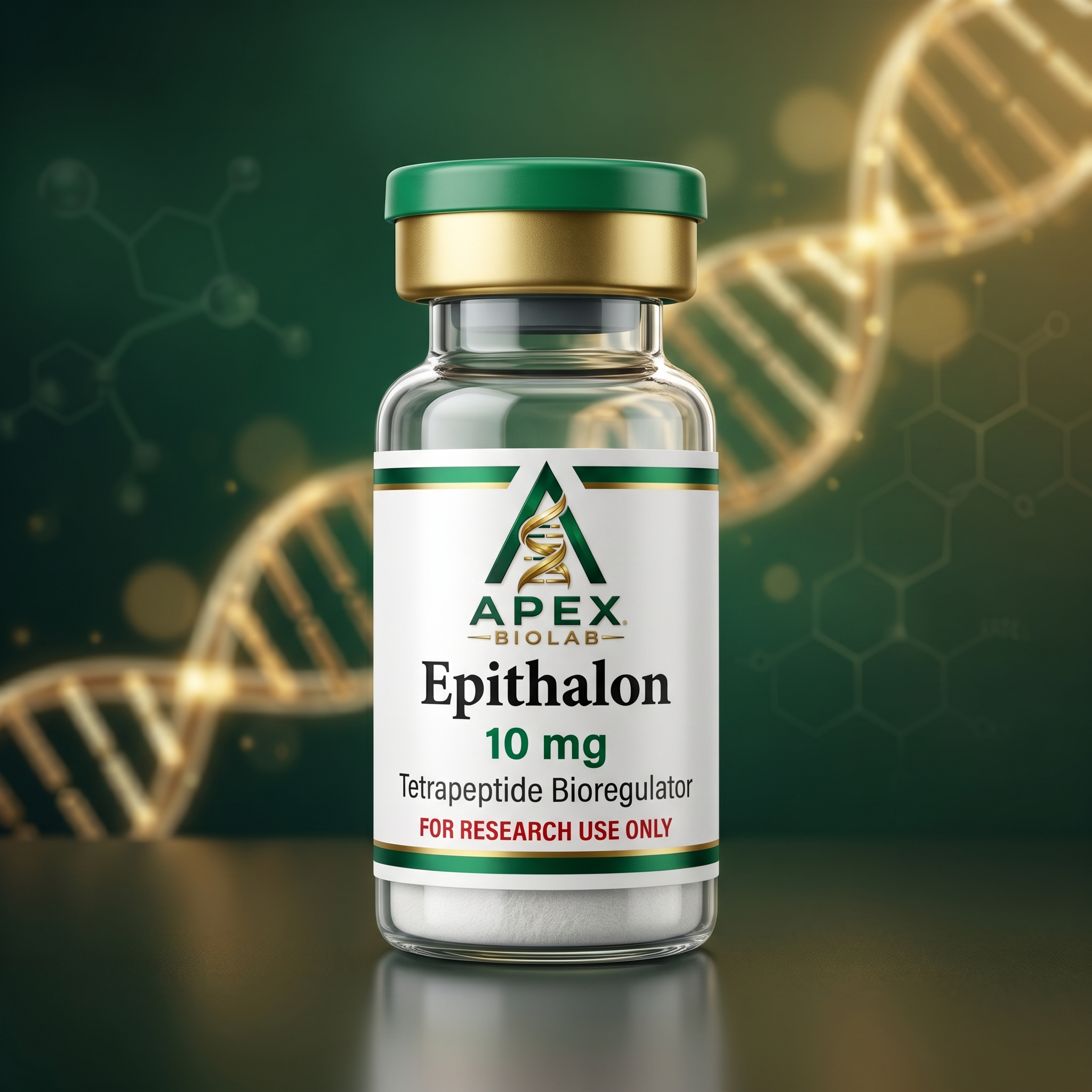
Epithalon
Four-amino-acid peptide studied for cell ageing, sleep rhythms, and pineal signalling.
For Research Use Only
Sold strictly for laboratory research. Not for human or veterinary use, ingestion, or clinical/diagnostic application.
The lower price is applied automatically once your cart holds 5 or more of this vial.
Bacteriostatic water included
About this peptide
Epithalon (also spelled Epitalon) is a four-amino-acid pineal peptide widely regarded as one of the premier compounds in longevity and anti-aging research. Inside every living cell, chromosomes are shielded by protective caps called telomeres—much like the plastic tips on shoelaces that prevent them from fraying. Each time a cell divides, these caps naturally wear down, eventually causing cells to slow down, stop dividing, and age. Epithalon works primarily by stimulating telomerase, the key enzyme responsible for repairing and rebuilding these caps, acting like a cellular reset button to keep cells biologically resilient and youthful. Beyond telomere protection, Epithalon revitalizes the brain's pineal gland. Rather than supplying synthetic melatonin, it prompts the body to produce its own natural melatonin again—restoring deep, restorative sleep cycles, realigning circadian rhythms, and strengthening the body's natural antioxidant defenses.
Why researchers reach for Epithalon
Telomerase studies
Referenced for hTERT expression in cell-line research.
Pineal-axis work
Modulates melatonin rhythms in animal models.
Bioregulator lineage
From the Khavinson short-peptide series.
Key features
- ≥99% HPLC purity
- Tetrapeptide bioregulator
- Mass-spec verified
- Cold-chain dispatch
How it works
Gene expression
Alters transcription of pineal and telomere-associated genes.
Circadian signaling
Restores melatonin rhythmicity in aged animal models.
Antioxidant markers
Adjusts SOD and catalase expression in vitro.
Research dosage guidelines
Reference ranges only — reproduced from published preclinical literature. Not a recommendation for human use.
| Range | Reported dose | Note |
|---|---|---|
| Typical reconstitution | 2 mL bacteriostatic water | Yields 5 mg/mL (5000 mcg/mL) |
| Reported research range | 500 mcg – 1 mg/day | 10–20 days on, repeated 2–3 times per year |
Tracking this compound? Registered researchers can log active Epithalon protocols in their private Research Log.
Timing in research protocols
Evening administration, supported by melatonin and cortisol rhythm findings in primates.
- Khavinson et al. (Neuroendocrinology Letters, 2001) found Epitalon stimulated melatonin synthesis in the evening in senescent monkeys, normalising the cortisol circadian rhythm.
- That primate finding is the only peer-reviewed basis for evening timing; no human clock-time comparison trial exists.
- Course-based regimens of around 10 days repeated periodically appear only in Russian clinical experience, without an accessible primary trial record.
- No meal relationship is reported in the published literature.
Drawn from published research protocols and pharmacology literature. Reference information for laboratory research only — not an instruction or guidance for use.
Technical specifications
- Sequence
- Ala-Glu-Asp-Gly
- Molecular weight
- 390.4 g/mol
- Purity
- ≥99% (HPLC)
- Form
- Lyophilized powder
- Vial size
- 10 mg
- Storage (lyophilised vial)
- Cool, dry and protected from light
- Storage (after reconstitution)
- 2–8°C
Published research
Peer-reviewed literature on Epithalon. Links open in a new tab.
Research use notice
Sold for in vitro laboratory research only. Not for human or veterinary use, diagnosis, or therapy.