
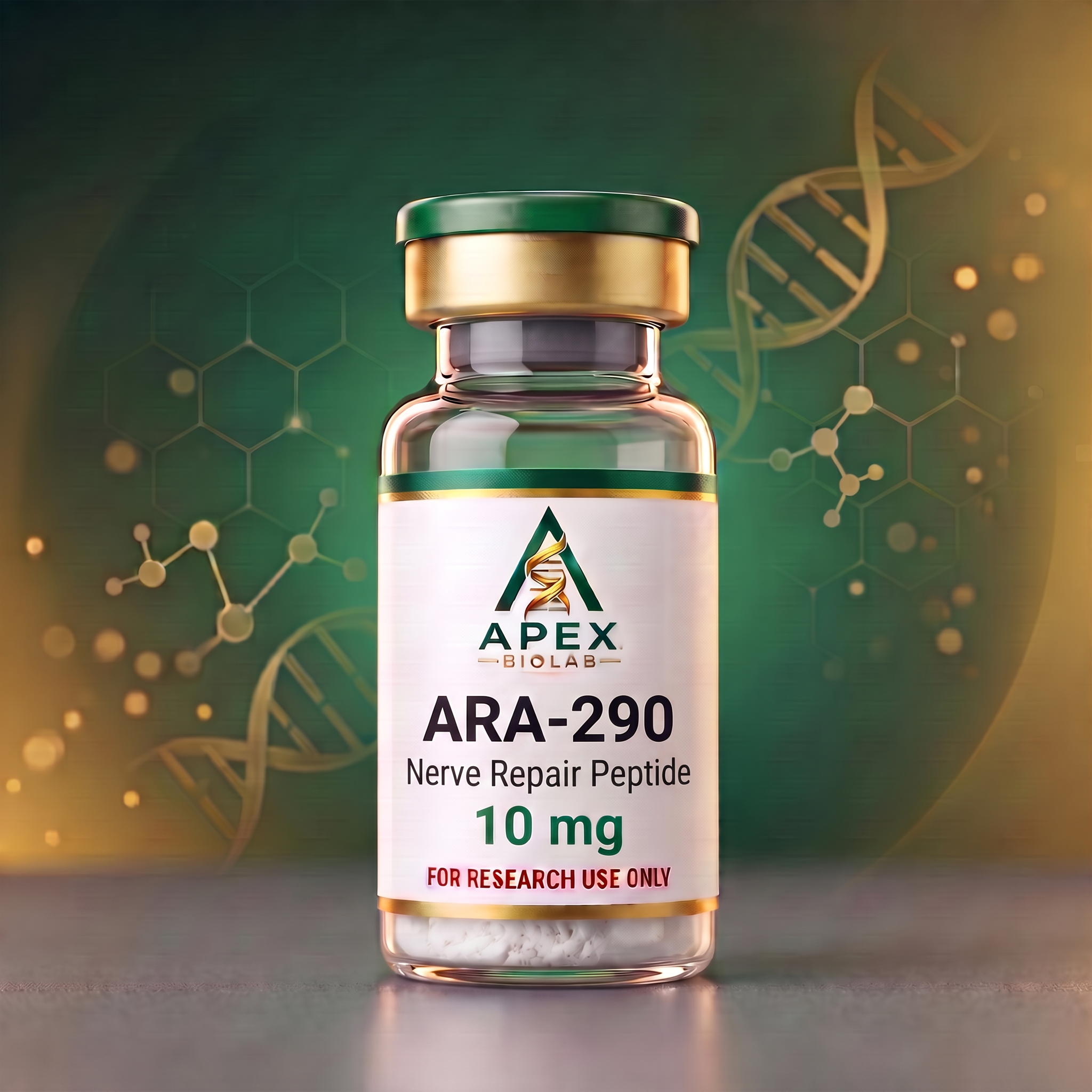
ARA-290
Small peptide based on erythropoietin, studied for nerve repair and calming inflammation — without boosting red blood cells.
For Research Use Only
Sold strictly for laboratory research. Not for human or veterinary use, ingestion, or clinical/diagnostic application.
Pricing coming soon
Contact us for a quote on this batch.
Bacteriostatic water included
About this peptide
ARA-290 (cibinetide) is an 11-amino-acid peptide designed specifically to protect and rebuild damaged nerves. It works by turning on the body's natural tissue repair switches, shutting down destructive local inflammation while shielding fragile nerve cells from further injury. In clinical trials for small-fibre nerve damage, ARA-290 was shown not just to calm burning neuropathic pain, but to actively stimulate the regrowth of healthy new nerve fibres—delivering powerful nerve protection and repair without affecting red blood cell counts.
Why researchers reach for ARA-290
Nerve-repair research
Human trials reported regrowth of small nerve fibres and reduced neuropathic pain.
Anti-inflammatory signalling
Studied for switching off inflammatory signalling and supporting tissue protection after injury.
No red-blood-cell effect
Activates EPO's protective receptor only, avoiding the blood-thickening effects of full EPO.
Key features
- 99%+ purity verified by HPLC
- Synthetic 11-amino-acid EPO-derived peptide
- Lyophilised powder for stability
- 10 mg research vial
- Bacteriostatic water included
- For laboratory research use only
How it works
Innate repair receptor
Selectively binds the EPO receptor / β-common receptor (CD131) complex, known as the innate repair receptor.
Cytokine dampening
Reduces release of pro-inflammatory cytokines such as TNF-α and IL-6 in injured tissue.
Neuroprotection
Promotes survival and regrowth of damaged small nerve fibres in animal and human studies.
Research dosage guidelines
Reference ranges only — reproduced from published preclinical literature. Not a recommendation for human use.
| Range | Reported dose | Note |
|---|---|---|
| Reported research range | 4 mg | Per administration, as used subcutaneously in human trials (Brines et al., 2014–2015). |
| Frequency | 1× daily | Clinical studies ran 28-day courses. |
| Typical reconstitution | 2 mL bacteriostatic water | Yields 5 mg/mL. |
Tracking this compound? Registered researchers can log active ARA-290 protocols in their private Research Log.
Timing in research protocols
Once daily over 28-day courses — clock time not specified.
- Human trials (Brines et al., 2014–2015) used 4 mg subcutaneously once daily for 28 days.
- Time of day and meal relationship were not studied variables.
Drawn from published research protocols and pharmacology literature. Reference information for laboratory research only — not an instruction or guidance for use.
Technical specifications
- Scientific name
- Cibinetide (pyroglutamate helix B surface peptide)
- Sequence
- pGlu-Glu-Trp-Leu-Glu-Arg-Ala-Arg-Asp-Gly-Ser-OH
- CAS number
- 1208243-50-8
- Molecular weight
- ~1257 Da
- Purity
- 99%+ (HPLC)
- Form
- Lyophilised white powder
- Vial size
- 10 mg
- Reconstitution
- 2 ml bacteriostatic water
- Storage (unopened)
- -20 degrees C, protected from light
- Storage (reconstituted)
- 2-8 degrees C, use within 30 days
Published research
Peer-reviewed literature on ARA-290. Links open in a new tab.
Research use notice
ARA-290 is supplied strictly for laboratory research. Not for human or veterinary use, ingestion, or clinical application.